
Conversation Intelligence Isn't Enablement Analytics. Here's What Is.
Sales enablement teams that invest in conversation intelligence usually do so to measure coaching impact. The logic is sound: if you can see what reps say on calls, you can measure whether training programmes change their behaviour, and whether those behaviour changes improve outcomes. What many find a year in is that the visibility is there but the measurement isn't.
The problem isn't the data volume. It's that most enablement teams have a measurement problem, and their conversation intelligence is usually measuring the wrong thing. Seeing conversations and measuring skill lift are different problems, and most CI tools only solve the first one - which is also why CI insights so rarely change rep behaviour.
Deal intelligence versus enablement-grade measurement
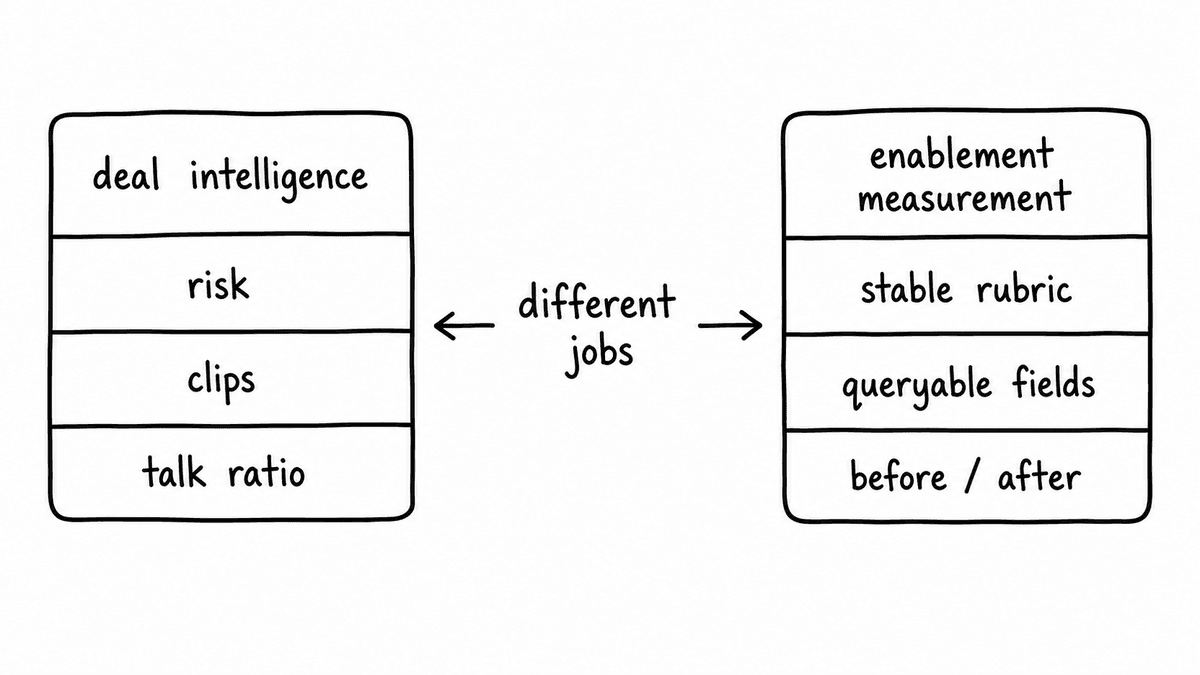
Most conversation intelligence is built for deal intelligence: surfacing risk in the pipeline, flagging competitor mentions, tracking whether next steps were agreed. That's useful for sales leadership. It isn't what enablement needs.
Enablement-grade measurement has three specific requirements that call dashboards don't fulfil: consistent rubric scoring across reps and cohorts, queryable fields that can be trended over time, and before-and-after data that connects training programmes to skill changes. A dashboard showing call-level highlights, top clips, and talk ratio trends doesn't produce any of those. It produces visibility into individual calls. That's a different thing.
If your scoring changes depending on which reviewer processed the call, which model version ran, or how the rubric was phrased that week, you're measuring noise, not skill lift. Consistent rubric scoring means the same framework question produces the same result regardless of which rep, which call, or when the evaluation ran. Without that, trend data is meaningless.
Why rep behaviour is the wrong signal for coaching
Most conversation scorecards measure what the rep did: talk ratio, questions asked, framework adherence, call structure. These are behaviours the evaluation can detect in a transcript, so they get measured. The problem is that they're inputs, not outcomes.
A rep can follow the framework on every call and still leave buyers without understanding. When enablement programmes are evaluated on framework adherence, coaching optimises the wrong thing - it produces reps who perform better on the rubric without running better conversations. AI scorecards are theatre unless they measure customer understanding - and most rubrics built around rep behaviour are exactly that.
The signal you want for enablement is buyer-side: did the buyer articulate specific pain, demonstrate understanding of the solution, commit to a next step? Those questions are harder to build a rubric around, but they're the ones that connect coaching to outcomes. A rep whose buyers consistently leave calls with clear pain articulation, confirmed timelines, and agreed next steps is producing better conversations - regardless of their talk ratio.
Building a rubric you can actually trend
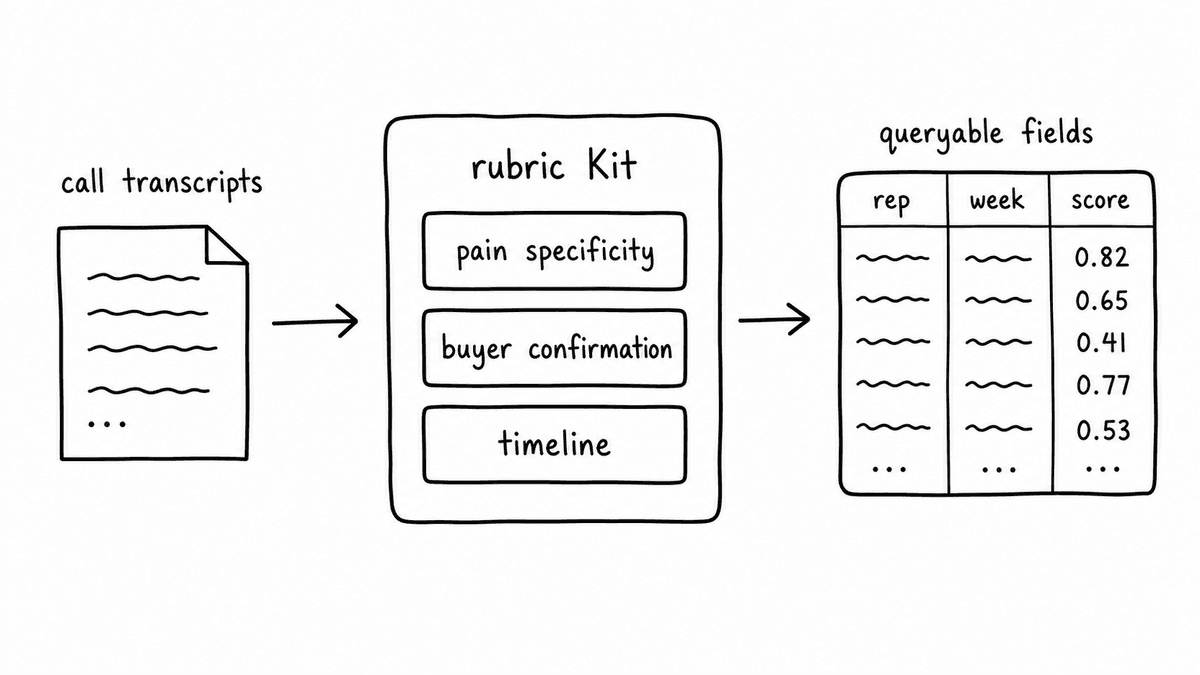
A practical enablement rubricstarts narrow: five to ten fields tied to the specific framework or skill you're developing. If you're running MEDDICC adoption, the rubric fields map to each element. If you're coaching discovery depth, the fields cover pain specificity, quantification, and buyer confirmation of the problem.
Each field needs a defined output type - yes/no, score, or category - and a definition that produces the same result regardless of who runs the evaluation. Test the rubric against a held set of calls before deploying it at scale. If two evaluators running the same call produce different results on the same field, the definition needs tightening before you can use it for trend data. A rubric that drifts between evaluators or between model updates is a source of noise, not signal.
Queryable fields mean the rubric outputs land in a data layer you can slice by rep, by cohort, by week, and by training programme. Call highlights in a UI are not queryable. Yes/no fields and scores in a schema are. This is the data-science workflow behind cohort skill-lift analysis - rubric outputs landing in Snowflake or BigQueryalongside CRM data. If you can't write a query that shows whether discovery depth scores for a specific cohort improved between Q1 and Q2, you don't have enablement analytics yet.
Before-and-after measurement
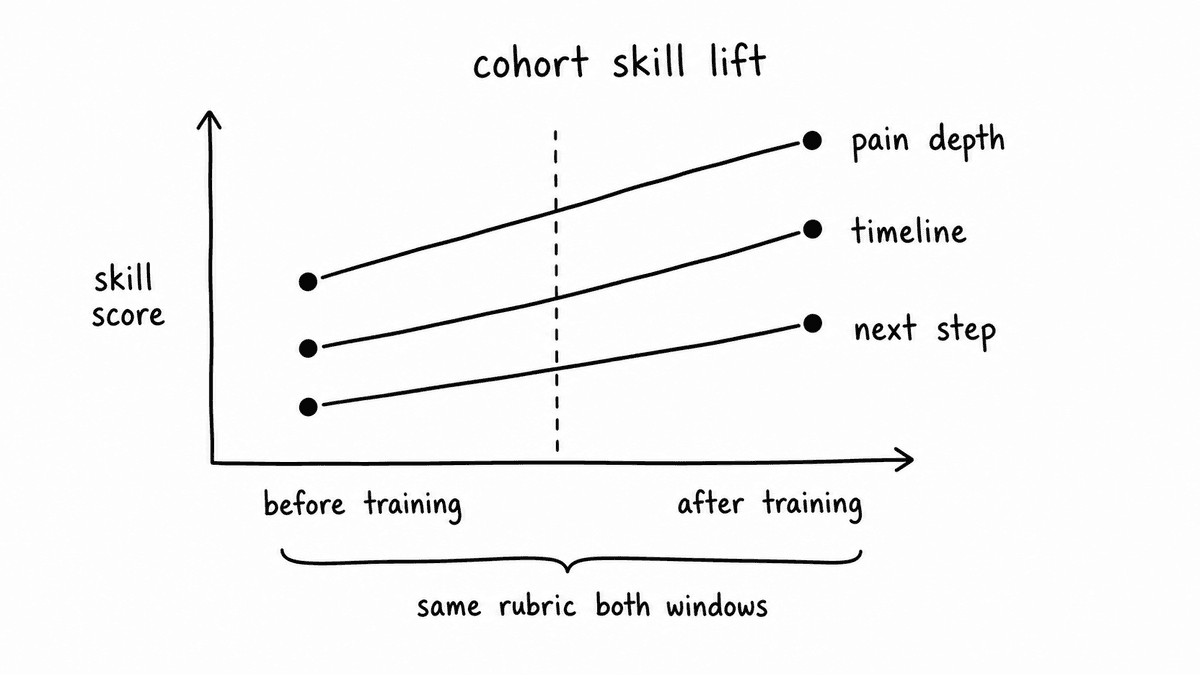
Once the rubric is stable, it becomes the benchmark. Run it against every call from the target cohort, starting several weeks before training through to the quarter after. The before-and-after data shows whether the programme moved the needle on the specific skills it was designed to develop. That's coaching ROI - not dashboard engagement volume or manager review counts.
The practical starting point is one framework and one coaching motion. Define five buyer-side rubric fields for that motion. Extract them consistently from calls using a locked evaluation schema. Trend those five fields across a cohort over one quarter. If the fields move in the direction you expected after training, you have evidence. If they don't, you have equally valuable evidence - and the data to figure out which specific skills need different coaching.
The sales coaching use case covers the full rubric design and evaluation workflow for enablement teams, including how to structure fields for cohort benchmarking.
How Semarize supports enablement measurement
Semarize is built around the evaluation contract model that enablement-grade measurement requires. You define the rubric as a Kit - a collection of Bricks, each asking one specific question with one defined output type. The same Kit runs against every call in your target cohort and returns typed JSON: yes/no fields, scores, extracted quotes. The schema is locked, so results are consistent across reps, across calls, and across model updates.
Because the outputs are structured fields rather than narrative summaries, they land in your data layer ready to query. Group by rep, filter by cohort, trend by week - the fields behave like any other structured data your BI tools can read. Before-and-after measurement works because the same schema runs continuously: there's no review step between the call and the rubric output, and no interpretation layer between the output and your analytics.
Knowledge grounding means your rubric can check against your actual sales methodology, not against what the model infers good discovery looks like. If your MEDDICC definition specifies that Metrics requires the buyer to state a number - not just acknowledge cost pressure - that standard is in the Kit, not left to model interpretation. The evaluation holds the same bar on every call.
Semarize produces consistent, queryable rubric scoring from every call. Define your enablement rubric, run it at scale, and trend the fields that matter.
Common questions
What rubric signals should we start with if we're using MEDDICC or BANT?
For MEDDICC, start with the three most extractable elements: Metrics (buyer quantifies the pain with numbers), Identify Pain (buyer states a specific problem), and Decision Criteria (buyer names what they're evaluating against). These tend to appear explicitly in transcripts when the rep asks for them directly. Add Economic Buyer and Champion once you've validated the initial three fields are producing consistent results. For BANT, Budget Confirmed and Timeline are the highest-signal starting points - both require the buyer to state something specific, which makes them extractable.
How do we validate that our rubric scores reflect buyer understanding, not rep performance?
Check what the rubric is actually measuring. If a field scores based on what the rep said - asked three questions, mentioned pricing, summarised next steps - it's measuring rep behaviour. If it scores based on what the buyer said - articulated a specific pain, confirmed a timeline, named a decision owner - it's measuring buyer understanding. Run the rubric against five calls and identify which fields depend on rep actions versus buyer responses. Rewrite any rep-behaviour fields as buyer-evidence fields before using the rubric for trend data.
How many conversations do we need to see skill lift trends without noisy scoring?
For reliable cohort trends, target at least 20 calls per rep per quarter. Below that, individual call variation dominates the aggregate. For programme-level measurement (pre/post training), aim for 50 or more calls in each window. The minimum viable approach is one cohort, one training programme, one before period and one after period, with a rubric that stays constant across both. Don't change rubric definitions between the before and after windows - any definition change creates a confound.
How do we handle scoring drift when models or prompts change?
Treat any evaluation schema change as a version bump, not a silent edit. Before rolling a new schema version, run it against your held call set and compare outputs to the previous version. If category distributions shift meaningfully, you need to decide whether to backfill historical scores or accept a break in the time series. For enablement trend data specifically, a mid-measurement schema change invalidates the before-after comparison - hold the schema constant for the duration of a measurement window, then version-bump at the start of the next period.
What if our current conversation intelligence tool doesn't produce queryable fields?
Then you have visibility into calls, not enablement analytics. The options are: export transcript data and run structured extraction through a separate evaluation layer that returns typed fields; push for API access to the underlying evaluation outputs and see whether the schema is flexible enough to add custom rubric fields; or treat your current tool as the call repository and pipe transcripts to an evaluation API that returns the structured fields you actually need. The conversation data is there - what's missing is the extraction layer that produces queryable outputs from it.
Continue reading
Read more from Semarize
Why Conversation Intelligence Doesn't Drive Behavioural Change (and What Does)
Eighteen months into a CI implementation, many teams find that call scores have improved but win rates haven't moved. The data is there. The dashboards are running. The coaching is happening. What's missing is the step where insight becomes a different behaviour in the next conversation - and CI alone doesn't close that gap.
AI Scorecards Don't Disagree. Your Prompt Does.
Inconsistent AI scorecards aren't an AI problem - they're a process failure. Freeform prompts ask the model to re-interpret evaluation criteria on every run, and that interpretation drifts with phrasing, model updates, and context. The fix is an evaluation contract: a locked schema with defined output types that produces the same result on the same call, every time.
AI scorecards are theatre unless they measure customer understanding
Most AI call scorecards measure what the rep did - agenda set, questions asked, next step mentioned. That's measuring inputs. What actually matters is whether the buyer understood anything. The two are not the same thing, and the gap between them is where scorecard theatre lives.