
Why Conversation Intelligence Doesn't Drive Behavioural Change (and What Does)
Sales teams that buy conversation intelligence usually have a clear expectation: coaching quality goes up, rep performance follows, win rates improve. The logic seems sound. The calls are being recorded, analysed, and scored. Coaching has data behind it now. What's left to do?
In practice, many teams get eighteen months in and find that call scores look better but the underlying performance metrics haven't shifted much. The CI stack is running. The dashboards are full. The coaching conversations are happening. The behaviour hasn't changed.
That outcome isn't a sign that the AI is bad. It's a sign that the implementation stopped one step short of the thing that actually changes behaviour.
Where conversation intelligence typically stops
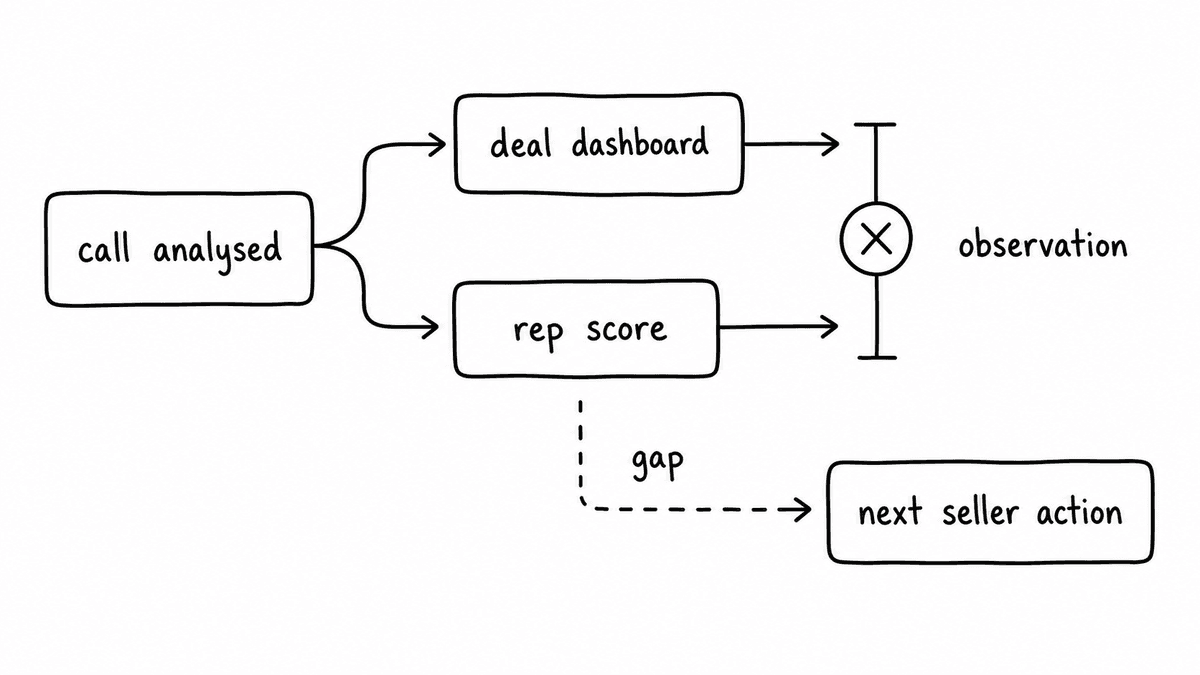
Most CI implementations produce two kinds of output: deal-level signals that feed pipeline reviews, and rep-level scores that feed coaching sessions. Both are useful. Neither, on its own, drives behavioural change.
Deal signals tell a manager which opportunities have risk. Rep scores tell a manager which reps are underperforming on which metrics. The dashboard shows what happened. What it doesn't do is force an action at the moment the rep decides what to do next - before the next call, when the coaching needs to land.
The gap is in the step between those observations and a change in what reps actually do on the next call. That step - the one where insight becomes a different behaviour - is where most CI programmes stall.
Why more insight doesn't produce better selling
The default belief behind most CI purchases is that if you surface better insights from calls, sellers will automatically improve. It feels right. The data is there; why wouldn't reps use it?
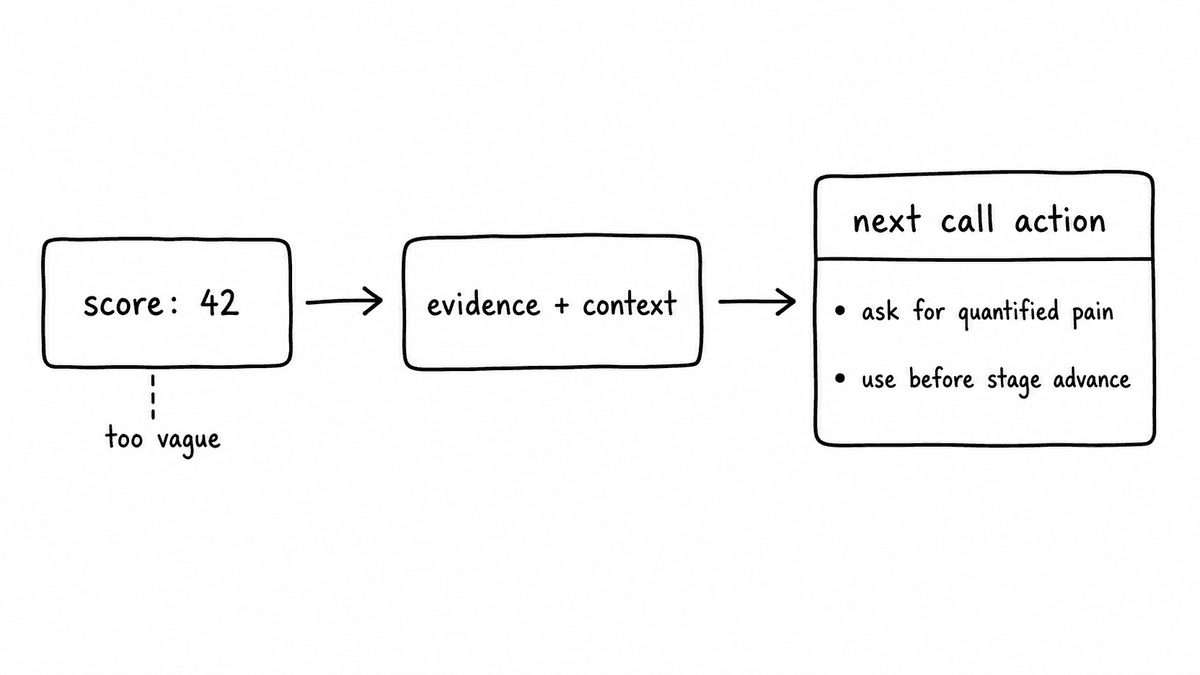
The problem is that insight without a clear operational decision point is just reporting. A rep sees their discovery depth score. They see they're below average on timeline confirmation. They go into their next call without a specific action to try, because “work on discovery depth” isn't an action - it's a category. The insight doesn't translate because the distance between a score and a changed behaviour requires an intermediate step that most implementations skip.
More insight compounds the problem if the insight is measuring the wrong thing. Rubrics built around rep behaviour - talk ratio, question count, framework adherence - tell you what the rep did. They don't tell you whether the buyer understood anything as a result. Coaching that optimises for those metrics produces reps who perform better on the scorecard without necessarily running better conversations. The measurement problem in AI scorecards is that most of them are measuring inputs rather than outcomes.
The missing layer: the next seller action
The real unit of value from conversation intelligence isn't the deal. It's the next seller action - triggered by what the customer actually understood in the moment.
What does that mean in practice? It means the output of an evaluation isn't just a score for the manager's dashboard - it's a specific, actionable prompt for the rep. Not “your discovery depth score is 42” but “you moved past pain before the buyer quantified it - here's the specific question that would have caught it, and here's where in your next discovery call to use it.”
That specificity only becomes possible when the evaluation is grounded in what the buyer actually said, not in rep behaviour proxies. The output needs to land where reps plan, follow up, and prepare for the next conversation - not in a review dashboard a manager checks on Friday.
Why coaching sessions don't close the gap on their own
Coaching from CI data tends to be retrospective. A call happens, it gets scored, a coaching conversation follows within a few days. The rep receives feedback about what they should have done differently. On the next call, they either remember to apply it or they don't.
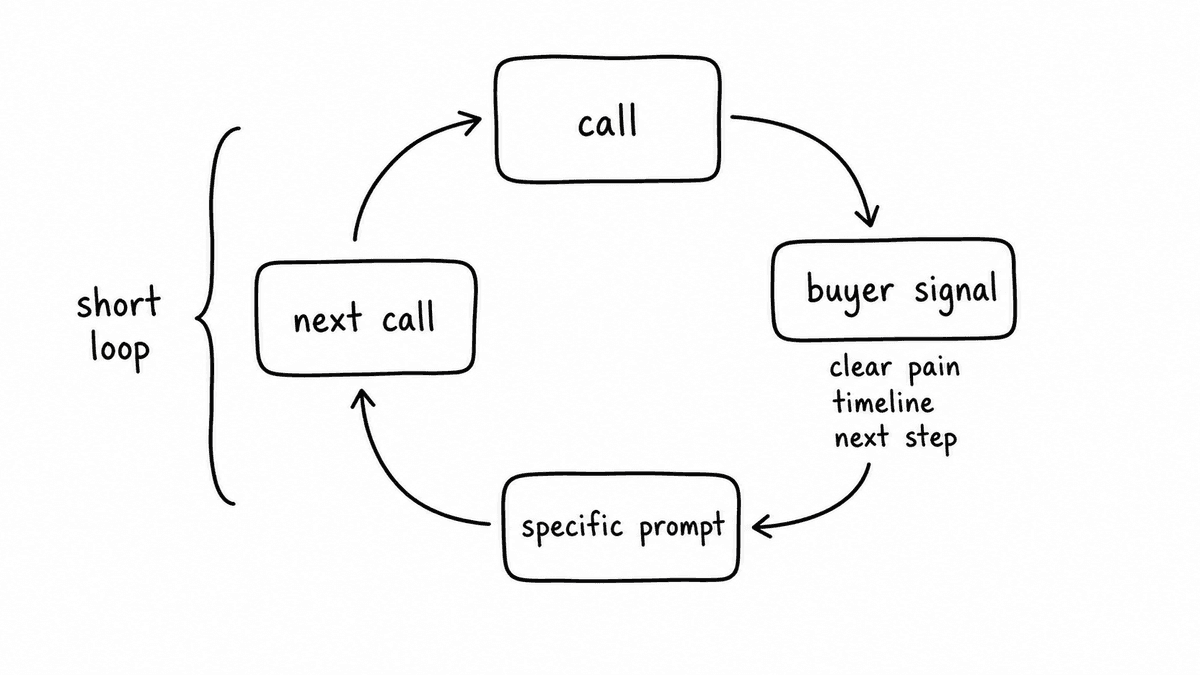
The memory component is the weak link. Skills transfer when the feedback loop is short and specific - when the observation and the corrective action are close together in time and context. A weekly coaching review based on a score from three calls ago is not a short feedback loop. It's a delayed, abstracted signal that competes with everything else in the rep's workflow for attention.
The teams that get behavioural lift from CI do two things differently: they shorten the feedback loop, and they make the coaching action specific enough to execute in the next conversation. Both depend on the evaluation producing outputs that are coaching-ready - not summaries for a human to interpret, but structured fields that can be routed directly into the rep's workflowat the moment they're preparing for what comes next.
Measuring the right thing
When coaching is based on buyer-outcome signals - did the buyer articulate specific pain, confirm a timeline, agree to a clear next step - the feedback becomes tied to something the rep can actually change: whether they create the conditions for the buyer to demonstrate understanding, not just whether they follow the talk track.
A rep can score well on every behavioural metric and still leave the buyer with no clarity on the problem, the product, or what happens next. Coaching that optimises for behavioural compliance produces reps who perform better on the scorecard. Coaching that optimises for buyer understanding produces reps who run better conversations - and that difference shows up in outcomes.
What to audit in your current CI stack
A useful diagnostic: what percentage of the insights your CI stack surfaces become a specific in-workflow action within the same rep session? If the answer is close to zero - if insights go to a manager dashboard and stop there - the implementation is producing reporting, not behaviour change.
The metrics worth adding alongside call coverage and summary completion: understanding signal extraction rate per call stage, next-step execution rate confirmed in transcript versus committed verbally, and coaching action specificity - whether the output is actionable enough for a rep to execute it on the next call without interpretation.
The sales coaching use case covers how to structure evaluation schemas that produce coaching-ready outputs - signals specific enough to feed a directed conversation rather than a general performance review.
What changes is what CI gets pointed at: what the buyer understood, rather than what the rep said. That shift - from measuring seller behaviour to measuring buyer understanding - is where CI implementations start to produce outcomes rather than observations.
Semarize evaluates conversations for buyer-outcome signals and returns structured data your coaching workflow can act on.
Common questions
Why doesn't surfacing more call insights produce behavioural change?
Insight without a clear operational decision point is reporting. A rep who sees their discovery depth score is low doesn't automatically know what to do differently on the next call. The gap between an observation and a changed behaviour requires a specific, actionable prompt - not a score - and most CI implementations stop before producing that. More insight compounds the problem if what's being measured is rep behaviour rather than buyer understanding, because it optimises for scorecard compliance rather than better conversations.
What is the difference between coaching visibility and coaching that changes behaviour?
Coaching visibility means a manager can see what happened on calls and which reps need attention. That's useful for pipeline reviews. Coaching that changes behaviour means a rep receives a specific, actionable prompt close enough to the next call that they can apply it - and the prompt is grounded in what the buyer actually said, not in what the rep did. The difference is whether the output lands in the manager's dashboard or in the rep's workflow at the moment they're preparing.
What do buyer understanding signals mean in practice?
Buyer understanding signals are extractable facts about what the buyer demonstrated in the conversation: whether they articulated a specific, quantifiable pain; whether they confirmed a timeline; whether they agreed to a next step with a specific owner and date. These are different from rep behaviour signals - they measure whether the conditions for a good outcome were created, not whether the rep followed the talk track. They're also extractable from transcripts, which means they can feed coaching without waiting for a manager to review the call.
How do you shorten the coaching feedback loop without adding to a manager's workload?
By automating the extraction step. When structured evaluation runs automatically after each call and produces specific, actionable outputs - not summaries for a manager to interpret, but fields a rep can act on directly - the feedback loop shortens because it no longer depends on a manager reviewing and translating the data. The manager's role shifts from interpreting CI outputs to verifying that the rep acted on them, which is a faster and more scalable coaching motion.
What should a CI output look like to be coaching-ready?
A coaching-ready CI output identifies a specific gap in buyer understanding, points to the exact moment in the transcript where it appeared, and suggests a concrete action for the next call. “Discovery depth: 42” is not coaching-ready. “The buyer didn't quantify pain - they mentioned cost pressure but gave no number. Before advancing stage, confirm a specific figure in the next call” is. The difference is whether the rep can act on it directly without interpretation from a manager.
Continue reading
Read more from Semarize
Conversation Intelligence Isn't Enablement Analytics. Here's What Is.
Sales enablement teams buy conversation intelligence to measure coaching impact, then find the dashboards don't produce what they need: consistent rubric scoring, queryable time-series data, and before-and-after skill lift metrics. Visibility into calls and measurement of skill development are different problems - and most CI tools only solve the first one.
Conversation Intelligence Produces the Signals. Outcomes Depend on What You Build With Them.
CI vendors sell outcomes - better forecasts, improved coaching, higher win rates. The outcome claims are accurate for teams that wire CI signals into their downstream workflows. For teams that don't, the dashboards fill up and the outcomes don't move. The gap between running CI and seeing results is always an implementation gap, not a vendor gap.
AI Scorecards Don't Disagree. Your Prompt Does.
Inconsistent AI scorecards aren't an AI problem - they're a process failure. Freeform prompts ask the model to re-interpret evaluation criteria on every run, and that interpretation drifts with phrasing, model updates, and context. The fix is an evaluation contract: a locked schema with defined output types that produces the same result on the same call, every time.