
Sales is human. Sales data is not.
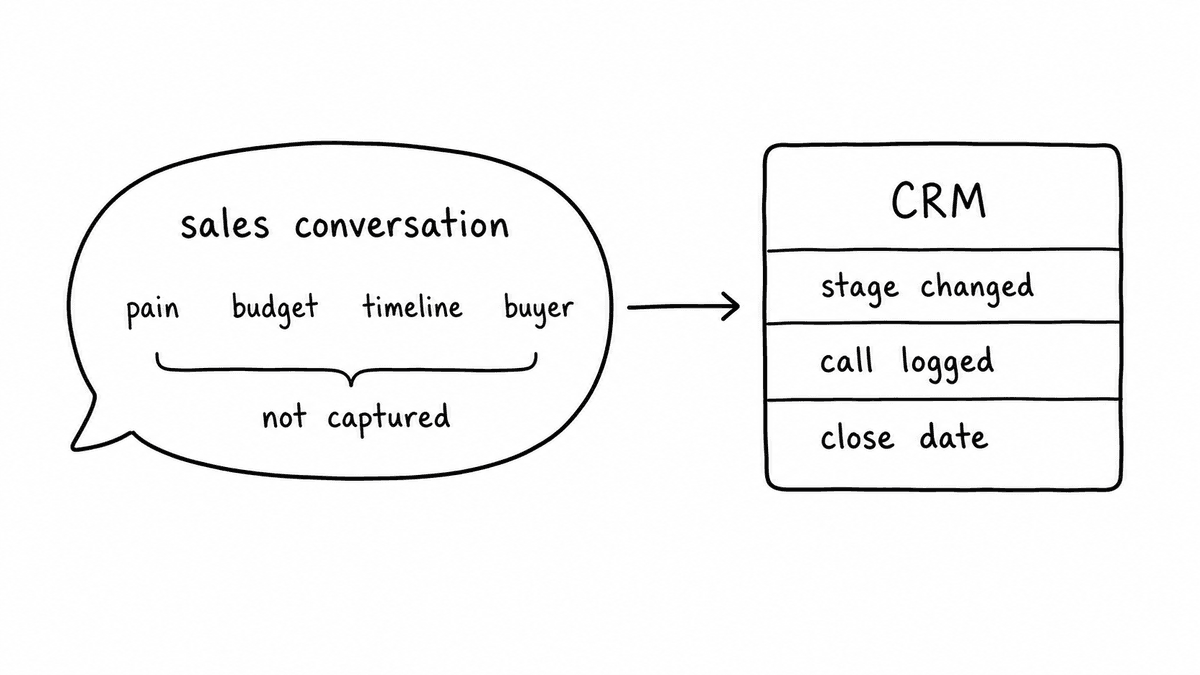
Most sales data is event-driven: it records what happened to an opportunity - stage changes, activity counts, close date shifts - not what happened inside the selling moment. A rep's discovery call where the buyer articulated a clear pain, confirmed budget, and named a decision timeline is logged in the CRM as “Discovery call, opportunity moved to Qualified.”
The selling was human. The data is a record of events, not of understanding.
What CRM data actually captures
CRM systems are built around objects: accounts, contacts, opportunities, activities. Those objects store state: what stage a deal is in, how many touches have happened, when the next task is due. That state is useful - it tells you what your pipeline looks like, not why.
Why is this deal at risk? CRM says it's been in “Proposal” for 45 days. But it doesn't say whether the buyer articulated a compelling event, whether procurement was mentioned, or whether the rep has spoken to the economic buyer at all. The answers are in the conversations; the CRM just has timestamps.
CRMs were designed to track pipeline, not to capture human interaction at the semantic level. The data model was built for deal management, and understanding what actually happened in the room has never been part of it.
The lag problem
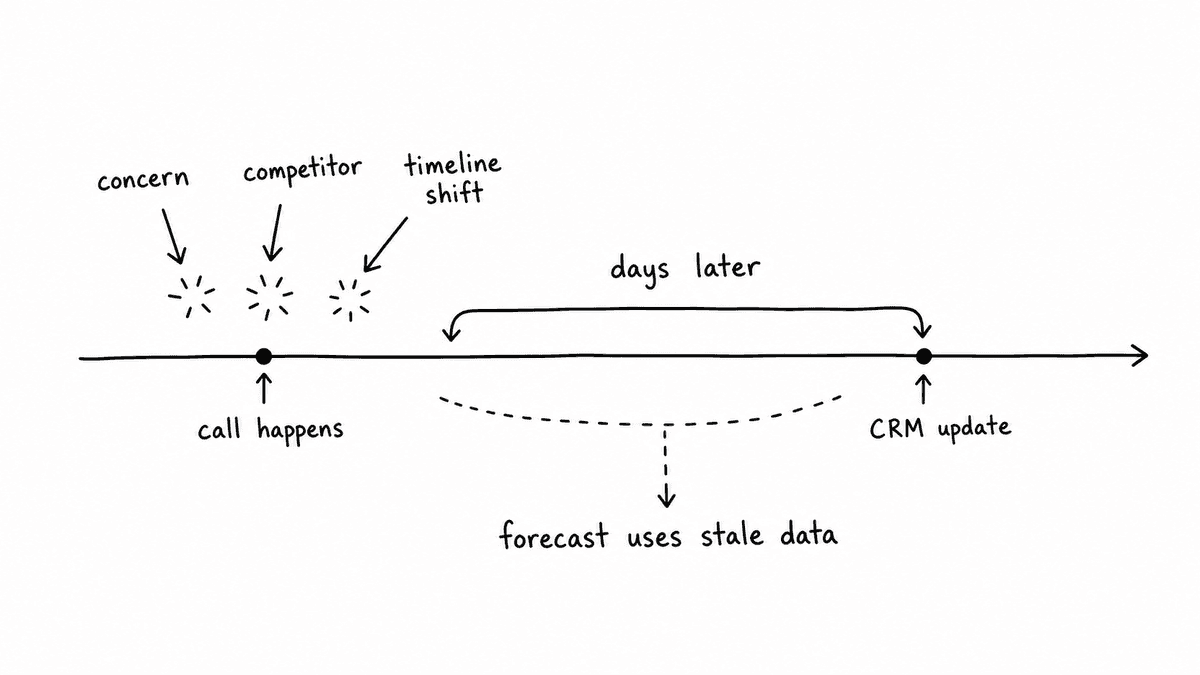
Because CRM data is event-driven, it always lags: something happens in a conversation - a buyer signals serious concern, a competitor gets mentioned, a timeline compresses - and that signal exists in the world immediately. It won't show up in your pipeline data until a rep updates a field, which may not happen for days, or at all.
The consequence is that every decision made from CRM data is made from information that's at least partially stale: forecast calls are based on opportunity stage and rep confidence, not on the actual evidence from the last conversation; coaching is based on outcomes - deals won and lost - rather than the behaviours that produced those outcomes.
You're making real-time decisions from delayed data, and the delay is structural - it's baked into how CRM data is created.
What the selling moment actually contains
Every sales conversation contains evidence - evidence of what the buyer understands, what they're willing to commit to, what's blocking progress, who else is involved, how serious the problem is. That evidence is present in real time, in the transcript, whether anyone captures it or not.
Most of it doesn't make it into any system: the best case is that a rep writes a call note that captures some of it. The more common case is that the call ends, the rep moves on, and the conversation data stays locked in a transcript somewhere - if it was recorded at all.
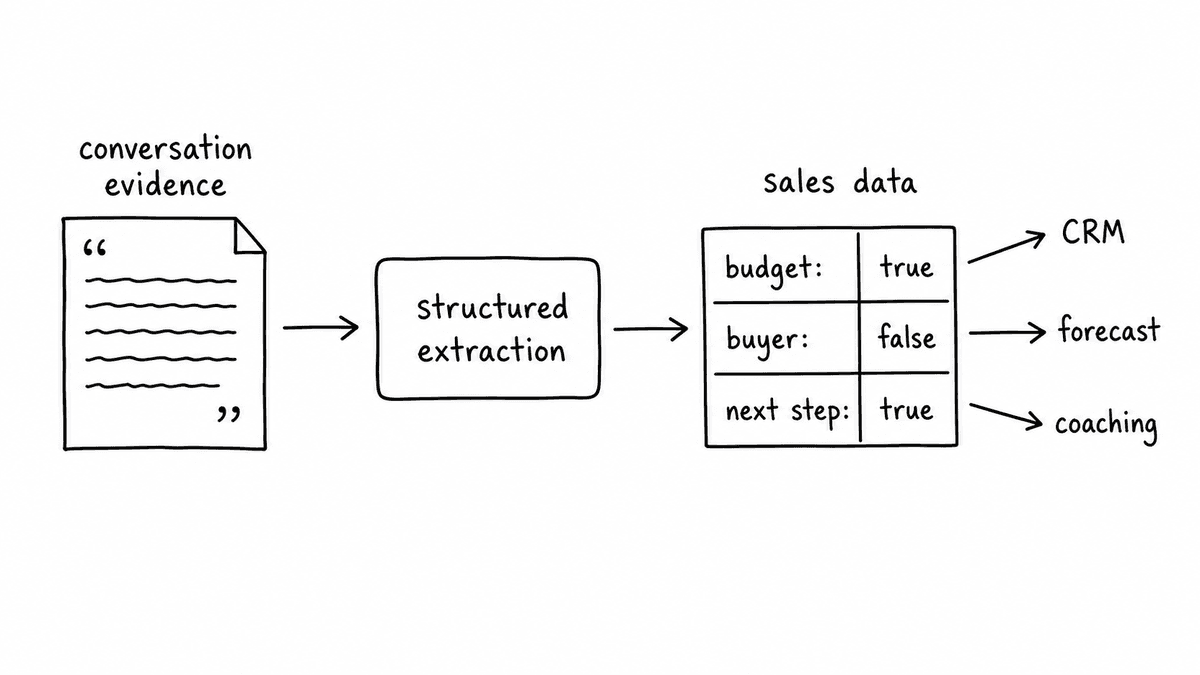
Extracting that evidence automatically - from the transcript, at the moment the conversation happens, pushed into the systems that need it - is what changes this. Not as a summary for a human to read. As structured data a system can act on.
What those signals look like as data
The signals that matter in a sales conversation are well understood: did the buyer articulate a specific problem, did they confirm a timeline, has the economic buyer been identified, what competitors came up? Every experienced rep knows what to listen for. The problem is turning what they heard into data.
Structured extraction returns the conversation as fields: next_step_confirmed: true, competitor_mentioned: "Salesforce", budget_confirmed: true, economic_buyer_identified: false. Yes/no values, extracted text, named entities - the same fields, in the same format, from every call. That's what makes it possible to ask whether deals with a confirmed budget and identified economic buyer at discovery close at a different rate, or whether competitor mentions in early-stage calls correlate with longer cycles. Those questions have always been worth asking; they've just never had the data to answer them.
Why CRM hygiene doesn't fix this
The standard response is better CRM discipline: cleaner field completion, mandatory updates, more rigorous pipeline hygiene. It helps at the margins. But it still produces event data entered by a rep, based on their interpretation, after the conversation ended - you get better coverage of the same limited signals. The underlying problem doesn't change: the data model captures what happened to an opportunity, not what happened inside the selling moment, and no amount of hygiene training closes that gap.
Why this matters for how you manage sales
When the data measuring selling is event-driven rather than evidence-driven, the decisions built on top of it inherit that limitation. Coaching that's based on outcomes rather than behaviours can't identify what needs to change before the outcome appears. Forecasting that's based on stage progression rather than buyer commitment signals can't distinguish a deal that will close from one that will slip.
The teams that are changing this add a conversation layer underneath the CRM - one that extracts structured signals from every conversation and pushes them into the stack alongside the event data that was already there. When those signals land in CRM fields, the pipeline picture is more complete. When they feed forecast models, the predictions get better. When they drive coaching, the feedback loop closes faster.
The selling was always human - the question is whether the data starts measuring that, or keeps measuring the events around it.
Semarize extracts structured signals from every sales conversation and returns them as structured data your systems can use directly.
Continue reading
Read more from Semarize
Capacity Planning Lags Because Sales Data Misses the Act of Selling
Sales capacity models built on CRM events are structurally late. Stage labels and activity counts record what happened to deals, not what was happening inside them. The missing ingredient isn't more pipeline data - it's structured signals from selling conversations that show whether buyers actually understood, committed, and progressed.
Overhiring Is a Measurement Failure, Not a Hiring Strategy
Sales teams don't overhire because of poor judgment. They overhire because CRM-driven capacity models are built on stage labels and activity counts - data that can't reveal whether buyers are actually progressing. By the time deal reality becomes visible, headcount decisions have already been made.
AI scorecards are theatre unless they measure customer understanding
Most AI call scorecards measure what the rep did - agenda set, questions asked, next step mentioned. That's measuring inputs. What actually matters is whether the buyer understood anything. The two are not the same thing, and the gap between them is where scorecard theatre lives.