
MEDDICC Without the Admin: Deterministic Scoring for Every Discovery Call
The sales teams that take MEDDICC seriously invest in training, rubrics, and process gates. They build out field definitions, run enablement sessions, and set expectations around form completion. Then they check the data six months later and find that field coverage is inconsistent, scores drift between reps, and the qualification picture still doesn't reflect what actually happened in the discovery call.
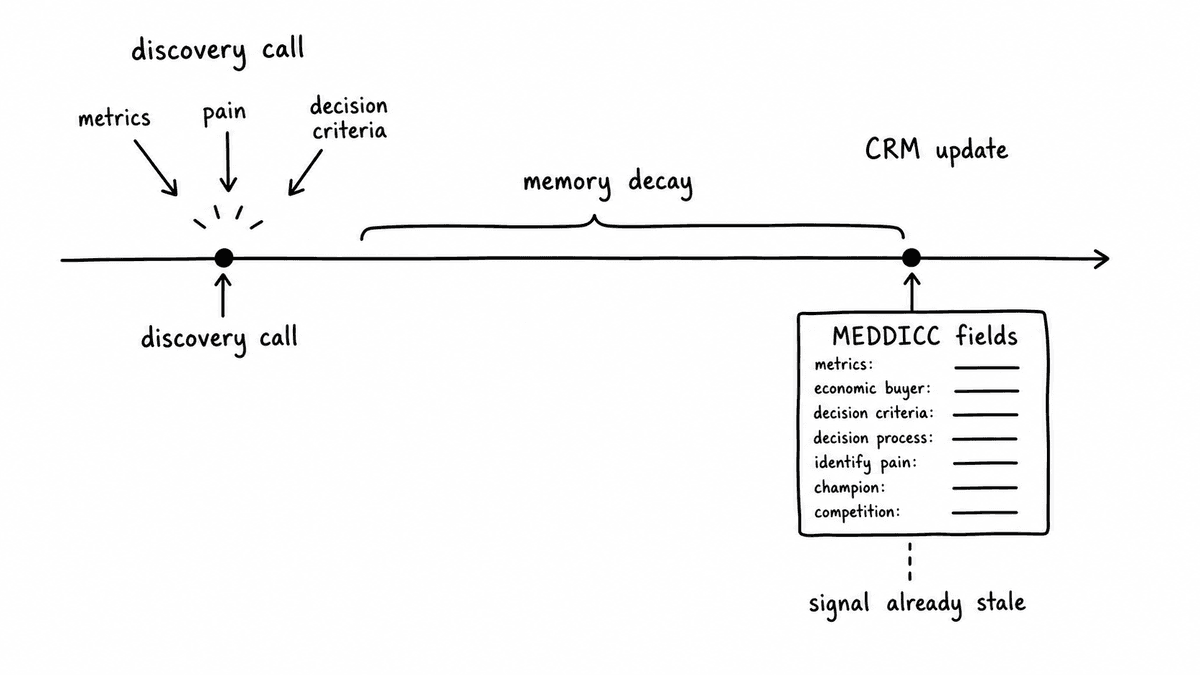
The problem is rarely the rubric. The problem is that the data feeding the rubric was produced hours or days after the conversation, from memory, by the same rep whose performance is being measured. By the time the MEDDICC fields get populated, the moment they should have captured has already passed.
Where MEDDICC breaks in practice
Manual MEDDICC updates create two structural problems: timing gaps and sampling bias.
The timing gap is straightforward. A buyer articulates a compelling event on a Wednesday discovery call. The rep updates the MEDDICC fields on Friday. That two-day window is where accuracy degrades - details get compressed, nuance disappears, and the score reflects what the rep remembers rather than what the buyer said. The CRM field reads as populated; the underlying signal is already stale.
Sampling bias is more insidious. Reps update fields more thoroughly on deals they're confident in and more lightly on deals they're uncertain about. The result is a qualification dataset that systematically overrepresents deals that look good and underrepresents the ones where the picture is murky - exactly backwards from what pipeline hygiene is supposed to produce. The deals that most need scrutiny are the ones with the least reliable data.
Why standardising the form doesn't fix it
The instinct when MEDDICC data quality is low is to tighten the process: require completion before stage advancement, add validation rules, run training on what each field means. This addresses the symptom while leaving the root cause intact.
Process pressure improves form completion rates. It doesn't improve data accuracy, because accuracy depends on what the buyer said in the call - and no amount of process enforcement makes a rep's post-call memory more reliable. Better enablement produces more thorough field completion from the same degraded source material.
The deeper issue is that manual MEDDICC updates ask reps to do two things simultaneously: sell the deal and document it accurately for the people evaluating whether they're selling it well. The incentive structures pull in opposite directions. Reps complete fields in ways that support their deal narrative rather than in ways that surface genuine qualification gaps. Tighter gates produce more complete MEDDICC forms that are no more reliable as a picture of deal reality.
Reframe: score buyer understanding, not form completion
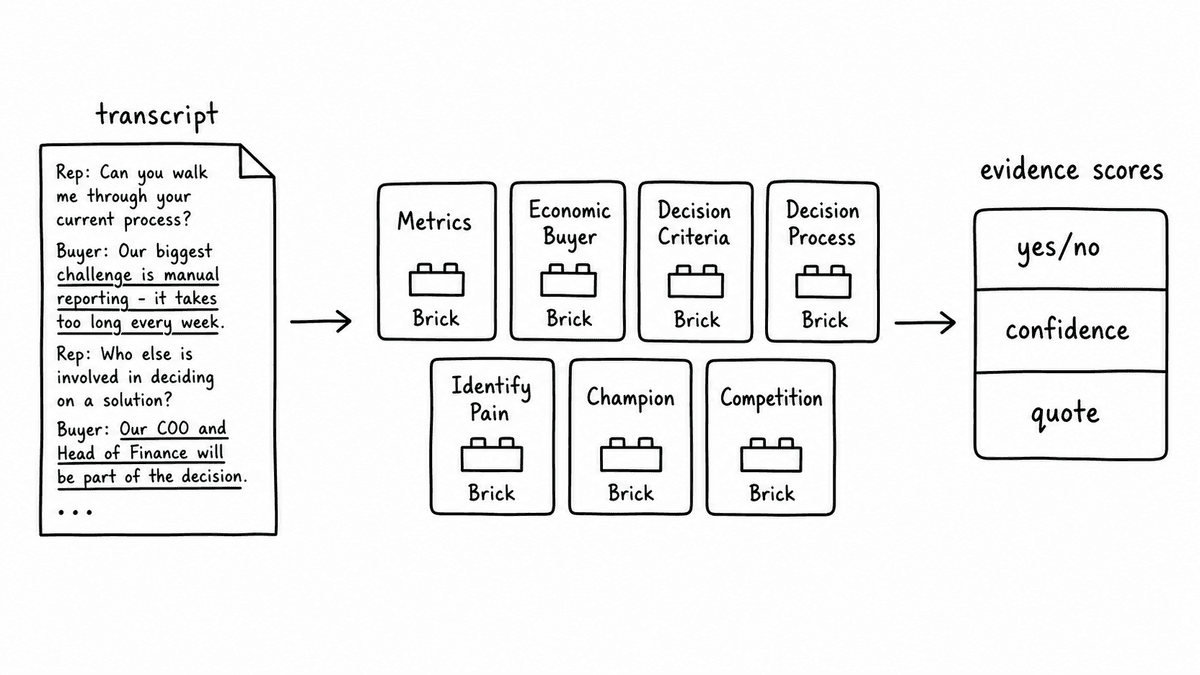
Each element of MEDDICC corresponds to a set of buyer signals that either appear in a transcript or they don't. “Metrics” is present when the buyer quantifies the problem with specific numbers. “Economic buyer” is identified when a name or role with budget authority is mentioned. “Decision criteria” exists when the buyer states what they're evaluating against. These are observable, extractable facts - not rep interpretations filtered through memory.
A structured evaluation schema scores each MEDDICC element against the transcript directly: yes/no for whether the signal appeared, with evidence spans showing exactly what the buyer said that supports the result. If the buyer didn't say it, the element doesn't score. No inference from rep effort, no benefit of the doubt for confident delivery, no Friday-afternoon best guesses.
The unit of work shifts: from the MEDDICC form to buyer understanding captured in the transcript and converted into deterministic fields you can score every time, on every call, without asking a rep to do it.
What the API-first pipeline looks like
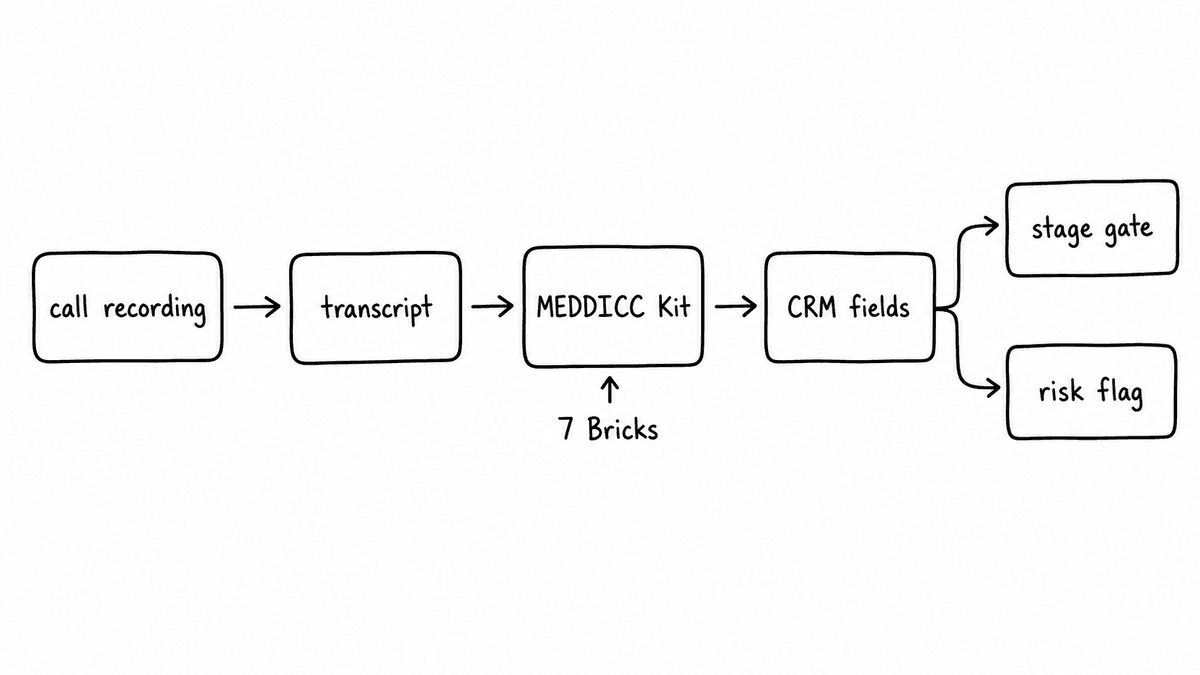
The pipeline has four steps: call recording to transcript, transcript to structured MEDDICC signals via the evaluation API, signals to CRM field mapping, and field values to workflow automation.
Each MEDDICC element becomes a Brick - a discrete evaluation unit with a defined output type. “Was a quantified pain mentioned?” returns yes/no with the buyer's exact words as evidence. “Was the economic buyer identified by name or role?” returns yes/no and the extracted name. “What decision criteria did the buyer state?” returns the criteria as extracted text. Seven elements, seven Bricks, one Kit that runs against every discovery call.
The output lands in CRM automatically - not when a rep remembers to update a field, but when the call is processed. Coverage becomes consistent across reps, across deal stages, and across time. The RevOps workflow routes each field value into the corresponding Opportunity property in Salesforce or HubSpot, triggering stage gates and risk flags based on evidence rather than form completion.
What to measure instead of completion rate
Once MEDDICC scoring is automated from transcripts, the metric that matters shifts from “did the rep fill in the form?” to “what percentage of discovery calls produced extractable evidence for each element?”
Low extraction rates on specific elements tell you something real. If decision criteria and economic buyer are consistently absent from discovery transcripts, those topics are rarely surfacing in the room - and no amount of CRM process enforcement will change that. That is a coaching signal grounded in what actually happened, not in what the rep reported. It tells you where the discovery framework is breaking down before the deal reaches forecast.
Extraction coverage by element, tracked per rep and per cohort, gives coaching teams a qualification picture that reflects discovery quality rather than administrative compliance. The deals that score low on economic buyer extraction need a different intervention than the deals that score low on metrics - and the data tells you which is which, at the moment the call ends, not at the end of the quarter.
Common questions
How do you score MEDDICC elements deterministically without human judgment?
Each MEDDICC element maps to specific buyer signals that are either present in the transcript or absent. “Metrics” scores when the buyer quantifies the problem with numbers. “Economic buyer” scores when a name or role with budget authority is mentioned. A structured evaluation schema extracts these signals and returns yes/no with evidence spans - the exact quotes that support each result. No inference from rep effort.
Which MEDDICC elements are easiest to extract from transcripts first?
Metrics, Identify Pain, and Decision Criteria are the most consistently extractable because buyers tend to state them explicitly when asked the right questions. Economic Buyer and Champion are harder - they often require reading context rather than explicit statements. Start with the three high-signal elements and expand once your extraction schema is validated.
What does “freshness” mean operationally for a RevOps team?
Freshness means the CRM field reflects what the buyer said in the call, populated at the time the call is processed - not what a rep recalled and typed in later. Operationally: every discovery call triggers extraction automatically; fields land in Salesforce or HubSpot within minutes; no manual update step sits between the conversation and the record. That gap is where accuracy degrades, and closing it is what freshness means in practice.
How do you prevent the model from scoring MEDDICC elements that weren't actually said?
Each evaluation Brick requires evidence to score - if no relevant buyer statement exists in the transcript, the Brick returns the signal as absent with a low confidence value and empty evidence spans. That absence is itself useful data: the element wasn't addressed in the discovery call. A hallucinated score has no evidence span to point to, which makes verification straightforward when you review results.
How does this integrate with existing Salesforce or HubSpot MEDDICC fields?
Each MEDDICC element returns yes/no and evidence text, which maps directly to existing Opportunity fields or custom properties you define. Your automation routes these into CRM via Zapier, Make, or direct API - fields update when a call is processed, not when a rep remembers to fill them in. Stage gates and risk flags built on those fields then run on evidence rather than form completion.
Semarize extracts MEDDICC signals from every discovery call and returns structured data with evidence for each element. Define your element schema, run it at scale, and measure what buyers actually said.
Continue reading
Read more from Semarize
CRM Enrichment From Sales Calls: The RevOps Data Ops Playbook
Most CRM enrichment stalls at 30% field coverage because the output is unstructured - reps updating from memory, summaries stored as notes. The fix is a structured extraction pipeline: transcript to consistent fields to CRM to automation triggers. This playbook covers the schema, the routing, and the implementation in Salesforce and HubSpot.
Stop Running Win/Loss Surveys. Start Capturing Deal Signals From Calls.
Win/loss surveys have a structural timing problem: they collect buyer memory after the outcome, not the decision inputs during the deal. Competitor mentions, pricing responses, and stakeholder dynamics exist in call recordings as they happen. Extracting them as structured signals makes win/loss real-time - and far more useful for deal coaching and pipeline risk.
Capacity Planning Lags Because Sales Data Misses the Act of Selling
Sales capacity models built on CRM events are structurally late. Stage labels and activity counts record what happened to deals, not what was happening inside them. The missing ingredient isn't more pipeline data - it's structured signals from selling conversations that show whether buyers actually understood, committed, and progressed.