
Introducing the Semarize MCP
We've shipped the Semarize MCP, and it changes how fast you can go from idea to running evaluation pipeline. Connect Semarize to Claude, Codex, or any MCP-compatible AI tool and you can describe what you want to measure in plain English. It drafts the Bricks, assembles them into a Kit, checks it's ready, and publishes it. Then chain the Semarize MCP with Make, n8n, or Zapier and you have a full CI pipeline: new call recorded, transcript evaluated, structured scores routed to your CRM or coaching tool. The whole thing in an afternoon, not a sprint.
From prompt to running Kit in minutes
Here's what it actually looks like. You connect the Semarize MCP and say something like: “I want to score sales discovery calls for MEDDIC. Check what Bricks we already have, fill any gaps, and draft a Kit.”Claude inspects your workspace, sees you already have a pain-specificity Brick and a timeline-confirmed Brick, creates two new ones for economic buyer and decision criteria, assembles all five into a draft Kit, and links you to it in the Semarize app to review and publish. You haven't written a single line of config.
Or you're iterating on an existing rubric: “Our QA Kit doesn't currently score for escalation handling. Add a Brick for that and update the Kit.” Claude reads your current Kit, creates the escalation Brick with an evidence-backed boolean output, adds it to the composition, and flags the updated draft for your sign-off. What used to be a back-and-forth across docs, your engineering team, and the Semarize UI is now a conversation.
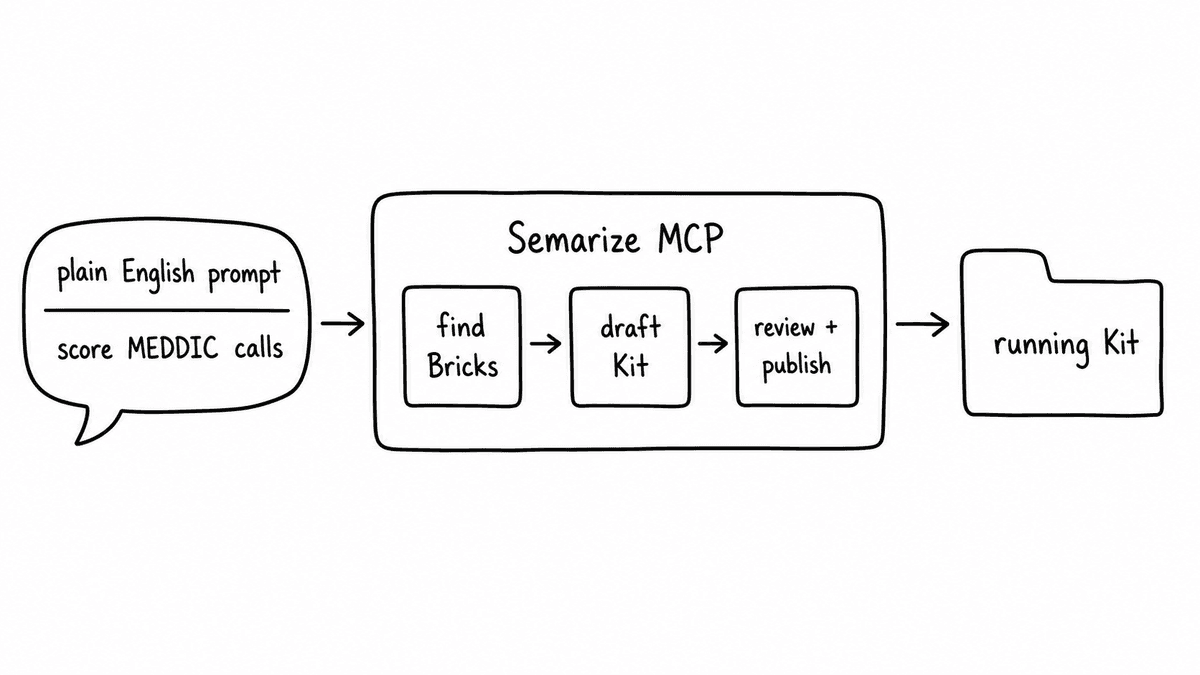
Chain it with Make, n8n, or Zapier to build full CI pipelines
The MCP is where the schema gets built. Once it's published, the Semarize REST API is what runs it, and that's where the automation MCPs come in. If you're using Make, n8n, or Zapier, you already have MCP connections to your calling platform, your CRM, and your team tooling. Add Semarize to that stack and the pipeline builds itself in the same session.
A real example: you're in Claude, Semarize MCP and n8n MCP both connected. You say: “Build me a pipeline where every new Gong call gets scored against our MEDDIC Kit and the results update the Salesforce opportunity.”Claude uses the Semarize MCP to confirm the Kit is published and get the kit code, then uses the n8n MCP to build the workflow: Gong webhook triggers transcript extraction, Semarize API call scores it, Salesforce fields update from the structured output. You review, activate, done. That pipeline would normally take a developer a day. With chained MCPs it's a conversation.
The same approach works for contact centre QA. Connect Semarize and Make: every call recording processed by your transcription service triggers a Make scenario that sends the transcript to your QA Kit, gets back a scored JSON object, and routes it to your QA platform and your coaching tool. No custom code. No waiting for engineering resource. You built the evaluation schema in the same session you built the automation.
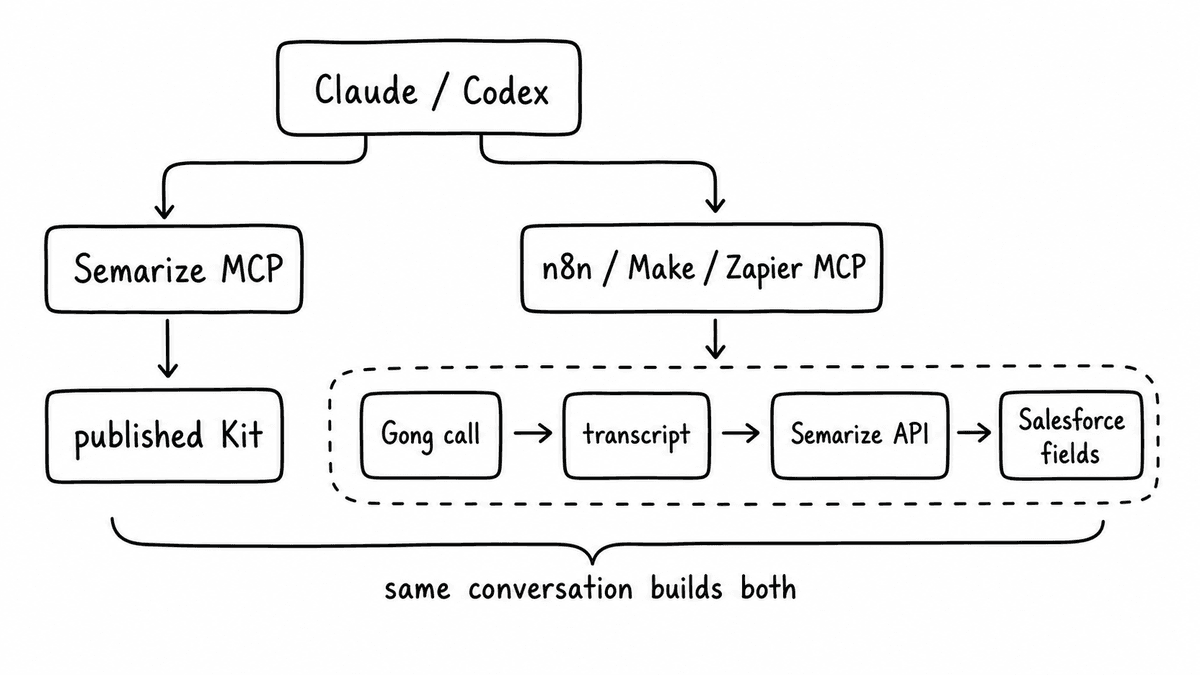
Built for RevOps and enablement teams who are done waiting on engineering
Semarize is for the teams who own evaluation quality but have historically needed engineering to implement it. RevOps leaders who know what good looks like on a discovery call but can't ship a scoring schema without a developer. Enablement managers who want methodology adherence tracked at scale but can't wait a sprint every time the rubric changes. QA leads who need structured, auditable output (not call summaries) routed directly into their platforms.
The MCP is what closes the gap. The schema lives in Semarize, versioned and auditable. The AI builds it from a conversation. The automation MCPs wire it into the rest of your stack. The whole pipeline from idea to running evaluation is yours to own, without the back-and-forth. The MCP quickstart will get you connected in under five minutes.
Common questions
What MCP clients does Semarize work with?
Claude and Codex both work out of the box via OAuth. Connect your Semarize workspace once and the tools are available in every session. Any other MCP-compatible client works the same way. The quickstart has the connection steps.
Can Claude publish a Kit without me reviewing it?
No. Publishing always requires your explicit confirmation. Everything Claude creates through the MCP is a draft. When a Kit is ready to publish, Claude surfaces any readiness checks (knowledge base requirements, governance blockers) and the publish only proceeds after you confirm. An AI agent proposing a schema change to your production evaluation pipeline without human sign-off is exactly the scenario the MCP is designed to prevent.
How does the Semarize MCP fit with Make, n8n, or Zapier MCPs?
The Semarize MCP handles schema authoring: building Bricks, assembling Kits, publishing. The automation MCPs handle workflow execution: triggering on new calls, routing structured outputs to your CRM, firing alerts. With Claude or Codex and an automation MCP both connected, you can build the schema and the automation in the same conversation: confirm the Kit is live, get its code, wire it into your existing stack.
Does the MCP run evaluations, or is that still the REST API?
The REST API runs evaluations: transcript in, structured JSON out via POST /v1/runs. The MCP builds and manages the schemas those evaluations run against. The two are intentionally separate: use the MCP to build and publish your Kit, then point your automation at the REST API to run production transcripts through it at scale.
How quickly can I actually go from nothing to a running evaluation pipeline?
For a straightforward use case (say, a sales discovery scoring Kit wired into a Make scenario that updates Salesforce) most teams are live in under two hours with the MCP approach. The majority of that time is reviewing the draft Kit and testing the automation scenario, not building. Schema design that used to require back-and-forth between RevOps, enablement, and engineering now happens in a single conversation.
Continue reading
Read more from Semarize
Conversation Intelligence for Developers: Don't Build a Fragile Pipeline, Don't Buy a Black Box
Most teams don't fail to add conversation intelligence because the model is bad; they fail because the integration is fragile and unstructured. The fix isn't a better LLM pipeline or a platform API you can't control. It's a layer that takes a transcript, runs it against a versioned Kit, and returns deterministic typed JSON you can test, version, and route into your product.
Bricks and Kits: the mechanism for stable conversation evaluation
Freeform prompts produce inconsistent evaluation results - scores drift, output shapes change, and you can't tell whether coaching improved anything or whether the rubric moved. Bricks define a locked evaluation schema: one question, one output type. Kits group them into reusable evaluation workflows. The result is schema-stable conversation analysis you control.
CRM Enrichment From Sales Calls: The RevOps Data Ops Playbook
Most CRM enrichment stalls at 30% field coverage because the output is unstructured - reps updating from memory, summaries stored as notes. The fix is a structured extraction pipeline: transcript to consistent fields to CRM to automation triggers. This playbook covers the schema, the routing, and the implementation in Salesforce and HubSpot.